The Clarion Investment Committee met on 20 January 2026. The following notes summarise the main points of consideration in the Investment Committee discussions, but have been updated to include commentary on recent events and the wider implications for financial markets.
Please click here to access our January Stock Market & Economic Commentary written by Clarion Group Chairman, Keith Thompson.
The Clarion approach to investment management
Our investment philosophy is guided by proven financial research, applied with care by our in-house Investment Committee. We do not chase trends or make predictions. Instead, we rely on evidence, structure, and oversight to manage wealth responsibly over the long term.
We focus on what can be controlled: diversification, discipline, and costs. This allows us to create efficient portfolios designed to weather uncertainty and deliver the returns that markets provide.
Our approach is built on five enduring principles, which together form the foundation of our Investment Philosophy.
Each of the five philosophy pillars reflects our commitment to managing your wealth with clarity, discipline, and care.
1) Evidence-based investing. Disciplined diversified portfolios deliver better long-term outcomes than chasing the latest market trend.
2) A systematic process. A structured repeatable process designed to remove guesswork and emotion.
3) Cost efficiency. We carefully select cost-effective investment solutions without compromising quality.
4) Independent oversight. Every decision is reviewed and challenged by our in-house Investment Committee, supported by Margetts Fund Management and Dynamic Planner.
5) A responsible perspective. Identifying risks and opportunities that could affect your wealth in the years to come and building resilience into client portfolios.
Economic commentary and market outlook
The following is a summary of the major events and economic news since the last Clarion Investment Diary.
Economics
- Activity accelerated in the UK and US and remained stable in the euro area in January, according to surveys of purchasing managers. The index shows UK activity growing at the fastest pace since April 2024.
- US president Donald Trump withdrew his threat to impose tariffs on European nations that opposed his plan for the US to take control of Greenland. Gold & Silver prices continued to rise amid the uncertainty, while the US dollar fell.
- Mr Trump threatened to impose 100% tariffs on all Canadian goods if Canada reached a trade agreement with China, saying that Canada would be a “drop off port” for Chinese goods entering the US.
- The US personal consumption expenditure price index, the Fed’s preferred inflation measure, increased marginally to 2.8% in the year to December.
- UK inflation rose to 3.4% in the year to December, up from 3.2% the previous month, driven by rising prices of alcohol, tobacco, and transport.
- The UK’s unemployment rate and average weekly earnings remained stable in the three months to December, at 5.1% and 4.7%, respectively.
- UK retail sales unexpectedly increased by 0.4% in December compared with the previous month, driven by strong sales by jewellery stores. Consumer confidence marginally improved in January, according to GfK.
- House prices across inner London fell at their fastest rate since the global financial crisis in the year to December, according to official data.
- The average maturity of sovereign debt across the eurozone is expected to fall below 10 years in 2026, the first time it has done so since 2015, according to analysis by Barclays, amid higher borrowing costs and waning demand for long-term debt by pension funds.
- German investor sentiment rose by more than expected in January to the highest rate since July 2021, according to research institute ZEW, with ZEW commenting that “2026 could mark a turning point” for Germany.
- The Bank of Japan held interest rates at 0.75% but signalled that future rate hikes are likely this year due to expectations of rising inflation. The Bank’s governor, Kazuo Ueda, warned of the “rapidly” rising yields on Japanese government bonds amid the recent snap election announcement and current prime minister Sanae Takaichi’s plans for further fiscal expansion.
- Saudi Arabian banks borrowed from international lenders at their fastest-ever pace last year, according to Fitch Ratings, as the Kingdom pushes forward with its Vision 2030 economic diversification plans.
- The US announced that countries “doing business” with Iran would face US tariffs of 25%. The move was criticised by China, Iran’s biggest trading partner.
- The price of a barrel of oil briefly rose above $65 per barrel before falling back as statements from the White House shifted from threatening imminent attack in Iran to saying they would “watch and see what the process is”.
- The US and Taiwan agreed on a trade deal that will see tariffs on most goods moving to the US cut from 20% to 15% in return for $250 billion in investment in the US semiconductor industry.
- US inflation was unchanged at 2.7% in the 12 months to December, providing some relief to investors who were concerned that the fall seen the previous month was a result of data distortions from the government shutdown.
- US Federal Reserve chair Jay Powell said that he was under investigation by the US Department of Justice over renovations of the Federal Reserve buildings. Mr Powell added that he believed the investigation was a result of his refusal to cut interest rates despite pressure from US president Donald Trump.
- Shipping giant Maersk announced it would resume navigation through the Suez Canal and Red Sea “following improved stability”, easing strains on global trade.
- The UK economy grew by a better-than-expected 0.3% in November as manufacturing output was boosted by Jaguar Land Rover resuming production following a cyber attack.
- The German economy posted growth of 0.2% in 2025, the first annual growth since 2022, despite a fall in exports, as consumer and government spending grew.
- China posted a record $1.2 trillion trade surplus in 2025 as a 20% fall in exports to the US was more than offset by an increase in exports to the EU, Southeast Asia, and Africa.
- The EU and the Mercosur trading bloc (Argentina, Bolivia, Brazil, Paraguay, and Uruguay) signed a landmark free-trade agreement after over 25 years of negotiation. The European Commission promised over €45 billion in support for its farmers to ease the passage of the deal.
- The UK government will be required to raise taxes again before the next election, according to a poll of leading economists conducted by the FT, amid weak growth and political pressures to increase public spending.
- UK house prices rose 0.6% in 2025, according to Nationwide.
- Over 200,000 jobs across the European banking industry, equivalent to 10% of the current workforce, could be lost to digitalisation and developments in AI, according to forecasts from Morgan Stanley.
- Bulgaria joined the euro area on 1 January, despite recent political protests that saw the prime minister resign in December last year.
- Data group S&P Global warned of a global copper shortage over the coming years, driven by high demand from the energy transition and the AI sector. Copper prices reached a record high of over $13,000 per tonne due to supply disruption concerns.
- UK new car sales in 2025 surpassed 2 million for the first time since 2019, according to the Society of Motor Manufacturers and Traders, driven by strong sales of Chinese electric vehicles.
- The UK military warned of a £28 billion funding shortfall over the next ten years that would need to be addressed to implement the government’s military modernisation plans, the FT reports.
- Euro area inflation softened to 2% in the year to December, down from 2.1% in November, according to initial estimates. The unemployment rate improved marginally to 6.3% in November.
Business
- US car manufacturing companies Ford and General Motors have been granted approval to set up banks in the US to provide automotive financing products.
- Mr Trump is suing US bank JP Morgan Chase for $5 billion over claims that the bank closed his accounts for political reasons.
- Social media company TikTok established a US-based data security unit that will allow the app to remain operational in the US, ending years of uncertainty caused by tension between the Chinese-owned company and the US government.
- Netflix changed its bid for Warner Bros Discovery’s studio and streaming business to an all-cash offer amid a continued battle against rival bidder Paramount. Warner Bros Discovery said its board had backed Netflix’s revised bid.
- European fintech company Revolut said it will scrap plans to buy a US bank and instead apply for a US banking licence itself, as it aims to quickly enhance its operations in the US.
- Global asset manager Vanguard announced plans to cut its exposure to UK bond and equity markets due to investors becoming more familiar with global diversification.
- The UK government is in talks with energy companies EDF and Centrica to extend the life of the Sizewell B nuclear power plant by 20 years, the FT reports, to ensure continued electricity generation from nuclear power while new plants are built.
- The UK government announced a £15 billion investment to upgrade 5 million homes with heat pumps, solar panels and batteries as part of its Warm Homes Plan.
- Elon Musk posted a poll on X asking whether he should buy Irish airline Ryanair following a disagreement with Ryanair CEO Michael O’Leary after Mr O’Leary refused to install Mr Musk’s Starlink internet services on the airline’s planes.
- An analysis published by the UK’s Office for Students showed that, despite the proportion of students achieving an upper second class or higher degree falling for a third consecutive year in 2023-24, there is still considerable evidence of ‘grade inflation’ since 2010-11.
- US president Donald Trump called for big technology companies to “pay their own way” to prevent rising electricity costs as a result of demand from data centres.
- Aircraft manufacturer Boeing secured more orders in 2025 than its European competitor Airbus for the first time since 2018. Boeing’s orders for 2025 from overseas include a number that were announced as part of US trade deals.
- The UK government announced upgrades to rail links across the north of England, including a new line between Liverpool and Manchester and, later, a line between Birmingham and Manchester in its “Northern Powerhouse Rail” strategy.
- Chinese electric vehicle company BYD overtook Tesla as the world’s biggest EV manufacturer last year, selling 2.3 million cars globally compared with 1.6 million sold by Tesla.
- US private companies SpaceX, OpenAI and Anthropic are preparing for public offerings, the FT reports, which could occur as early as this year.
- Energy companies Equinor and Ørstedlaunched legal action against the US government in a bid to overturn a government order to halt construction of offshore wind projects.
- Danish pharmaceutical company Novo Nordisk launched a weight loss pill in the US, costing significantly less than the injectable version of the drug, the latest release in an increasingly competitive weight loss market.
- Mining companies Glencore and Rio Tinto said they are restarting merger talks, after previous talks collapsed in 2024. A merger could create the world’s largest mining company with a current value of more than $260 billion.
- Britain’s opposition Conservative Party said it would follow Australia and ban under-16s from accessing social media platforms if it wins power.
- The UK government is expected to announce a climbdown on rises to business rates bills faced by pubs in England. If it does, it would be the government’s fourth major reversal on proposed measures to increase government revenues.
- US pharmaceutical company Merck is considering the purchase of cancer drugmaker Revolution Medicines in a deal worth up to an estimated $32 billion, the FT reports.
- RG Barry, the US subsidiary of Japanese investment company Marubeni, bought UK sportswear brand Gola amid the current popularity for retro trainers.
- Hiring rates by UK electricity network owners are at their highest level in decades, reflecting the pace at which building the transmission infrastructure is required to support the energy transition.
- Aldi and Lidl reported record sales in the run-up to Christmas last year and took their largest market share of the Christmas grocery market to date.
- Large, London-based companies are choosing not to move office premises due to a slump in the construction sector that has resulted in a shortage of high-end buildings, as well as rising fit-out costs. Companies are instead extending leases and refurbishing existing office spaces, the FT reports.
Global and political developments
- US, Russian, and Ukrainian negotiators met in the UAE for talks aimed at ending the war in Ukraine.
- Prior to the talks, Russian president Vladimir Putin said he would not agree to ending the war unless Ukraine made territorial concessions.
- Mr Trump criticised the UK’s deal to transfer ownership of the Chagos Islands, which hosts a US military base, to Mauritius, calling it an “act of great stupidity” and a reason why the US should acquire Greenland.
- Mr Trump later said he would not take control of Greenland by force and withdrew his threat of imposing tariffs on European nations that opposed his plans. Mr Trump said he and NATO secretary-general Mark Rutte had “formed the framework of a future deal” for Greenland.
- Iranian authorities seized properties and businesses as part of an intensifying crackdown on protests across the country. The US government said it has sent naval forces towards Iran “just in case” the US needed to take action against Tehran.
- Mr Trump announced his “Board of Peace” at the World Economic Forum in Davos last week. The board may present an alternative body to the United Nations, with initial members including the leaders from Israel, Saudi Arabia, Hungary, Argentina, and Belarus. Vladimir Putin has yet to respond to his invitation, while the UK has not yet agreed to join due to Russia’s possible participation.
- Jared Kushner, Mr Trump’s son-in-law, unveiled a $30 billion vision for the rebuilding of Gaza at the unveiling of Mr Trump’s Board of Peace.
- The UK government approved China’s plans for a “mega” embassy in London after officials said they had devised protective measures to counter concerns of Chinese espionage.
- The Labour Party has blocked Greater Manchester mayor Andy Burnham from standing as a parliamentary candidate. Had Mr Burnham been selected and won the seat, he would have been well placed to challenge Keir Starmer for the leadership of the Labour Party.
- The UK government is preparing to launch an independent review to consolidate the number of police forces in England and Wales, the FT reports, as part of reforms to increase the effectiveness of the police service.
- Thousands of people are reported to have been killed in Iran as authorities cracked down on widespread protests. Mr Trump vowed “very strong action” if protestors were executed and later claimed he had it on good authority that the killings had stopped.
- The EU is considering creating a ‘membership-lite’ option to allow Ukraine to quickly join the EU as part of any peace deal with Russia, the FT reports.
- Former Conservative leadership candidate Robert Jenrick announced he was joining Reform UK after being sacked from the shadow cabinet for “plotting in secret to defect”.
- Conservative MP Andrew Rosindell announced he was defecting to Reform UK.
- The US began sales of Venezuelan crude oil with a transaction worth $500 million, CNN reports. The US has previously said it will control oil sales “indefinitely”.
- Japanese prime minister Sanae Takaichi announced snap elections will take place next month as she seeks a new mandate to pursue policies including fiscal stimulus and higher defence spending.
- Venezuelan opposition leader María Corina Machado presented Donald Trump with the Nobel Peace Prize medal she was awarded last year. Mr Trump has previously said that Ms Machado lacks the support to lead Venezuela.
- UK prime minister Keir Starmer said he wants a closer alignment between the UK and the EU’s single market, saying it is in the UK’s national interest for a tighter UK-EU relationship.
- The number of migrants arriving in the UK via small boats increased to nearly 41,500 in 2025, a 13% increase from the previous year.
- The UK government said the UK and French militaries bombed an underground weapons store in Syria used by ISIS militants.
- Ukrainian president Volodymyr Zelenskyy announced a reshuffle of his top team following a previous government corruption scandal.
- Zohran Mamdani was sworn in as New York’s mayor after his election success, pledging to freeze rents, introduce free childcare and buses, and impose higher taxes on millionaires.
- Russia used a hypersonic missile to hit infrastructure facilities in western Ukraine last week.
- The UK and France committed to deploying troops in Ukraine as part of a potential peace deal. The US previously agreed to defend Ukraine against future attacks.
- An internet blackout occurred in Iran amid continued protests against the government. Iran’s supreme leader, Ayatollah Ali Khamenei, said that the protesters were acting for Mr Trump.
- The UK government said it will exclude the City of London from its push for greater cooperation and alignment with the EU following concerns from the finance industry over changing regulatory frameworks, the FT reports.
Strategy and summary
- The bond allocations within the portfolios target short and mid sections of the yield curve where capital appreciation is expected.
- Index-linked bonds are also included in the bond allocations as a hedge against persistent inflation.
- High-yield bond strategies are avoided as credit spreads do not currently offer a worthwhile risk premium.
- The US equity market is underweighted on a valuation basis and strategies within the portfolio are particularly underweight mega-cap stocks.
- The UK equity market is conversely overweighted on a valuation basis.
- Asia, Emerging Markets and China are also overweighted as they trade below their long-term historical average. The IC believe these regions have the potential to grow their valuations in the long-term from a low base.
- UK and US small and mid-cap equity allocations are also included based on an attractive entry point, which current valuations provide.
- The performance of all funds was compared against their IA sector benchmarks, observing that most have performed well, particularly Dimensional European Value, which has significantly outperformed.
- No changes to the underlying funds were considered necessary as all funds are performing in line with expectations and within their risk-reward parameters.
- Despite ongoing geopolitical tensions, we are cautiously optimistic about stock markets in 2026 and see valuation opportunities in the US beyond the big tech stocks and in markets outside the US, particularly the UK, Europe, Asia, and Emerging Markets, where valuations are generally more attractive, which will help to offset some of the economic headwinds and geopolitical uncertainty.
Clarion Portfolio Funds
Prudence Portfolio Fund
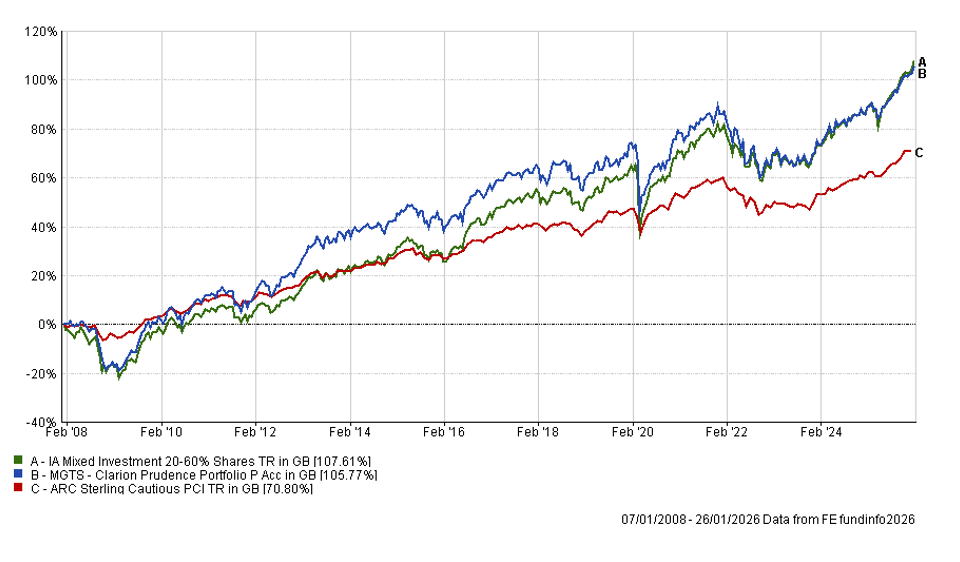
The chart below shows the historical performance of the Prudence Portfolio against a relevant benchmark since the start of the available data.
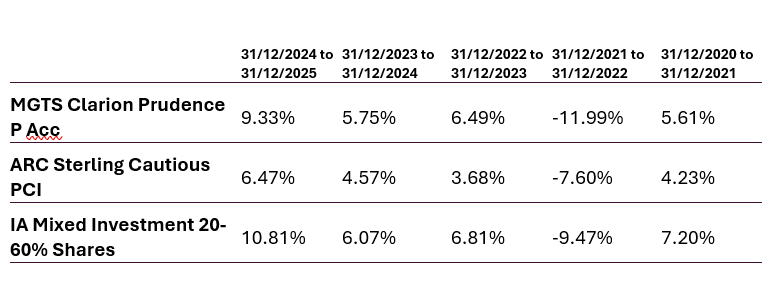
The table below shows the annualised performance to the last quarter end:
Changes to the Prudence Portfolio Fund
Navigator Portfolio Fund
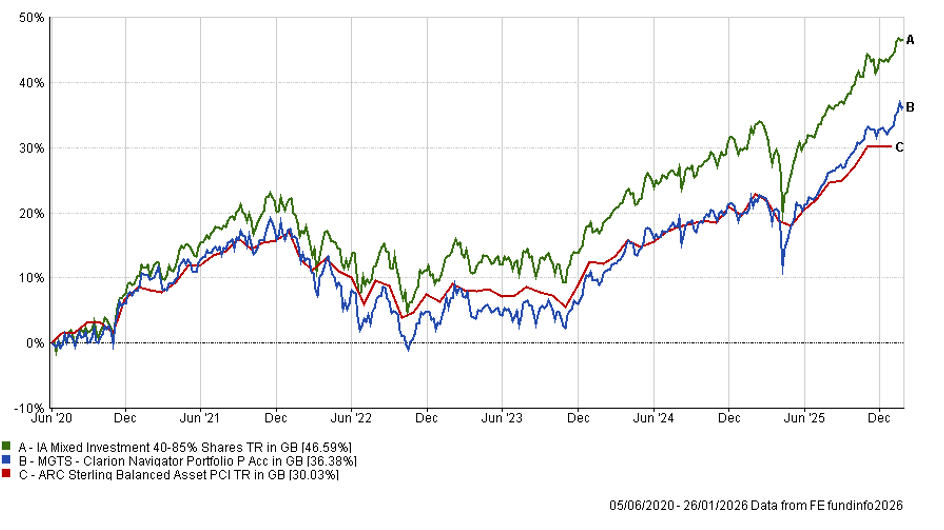
The chart below shows the historical performance of the Navigator Portfolio against a relevant benchmark since the start of the available data.
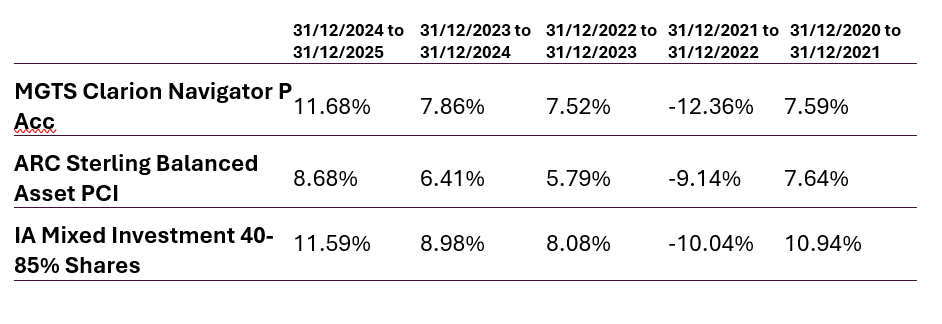
The table below shows the annualised performance to the last quarter end:
Changes to the Navigator Portfolio Fund
Meridian Portfolio Fund
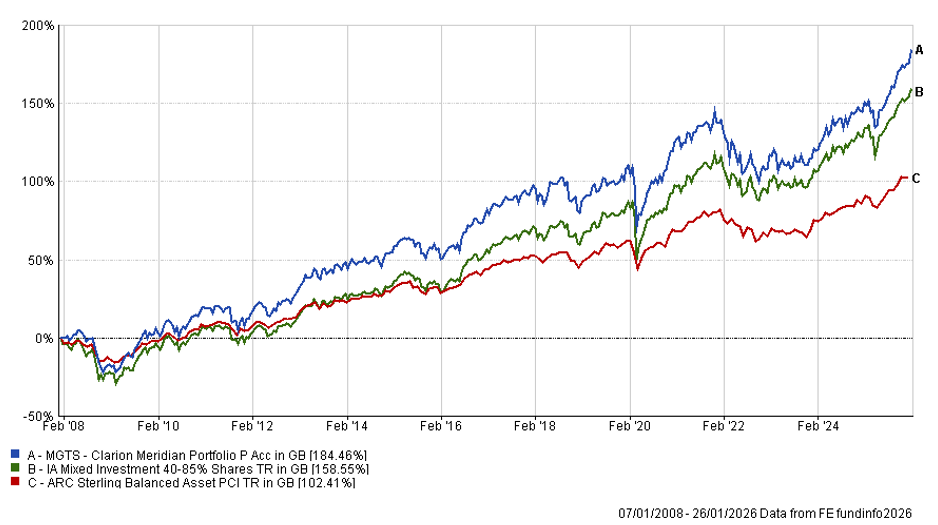
The chart below shows the historical performance of the Meridian Portfolio against a relevant benchmark since the start of the available data.
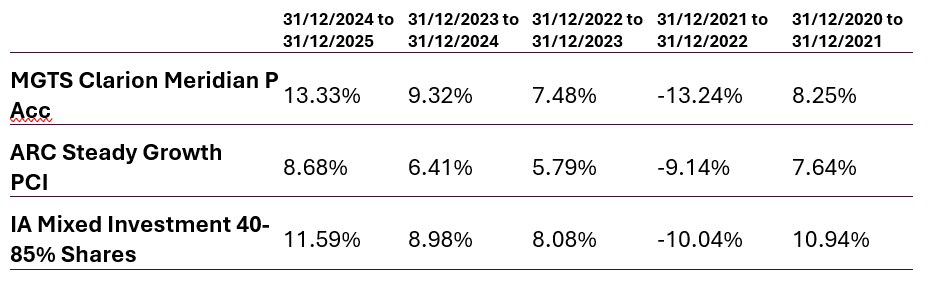
The table below shows the annualised performance to the last quarter end:
Changes to the Meridian Portfolio Fund
Explorer Portfolio Fund
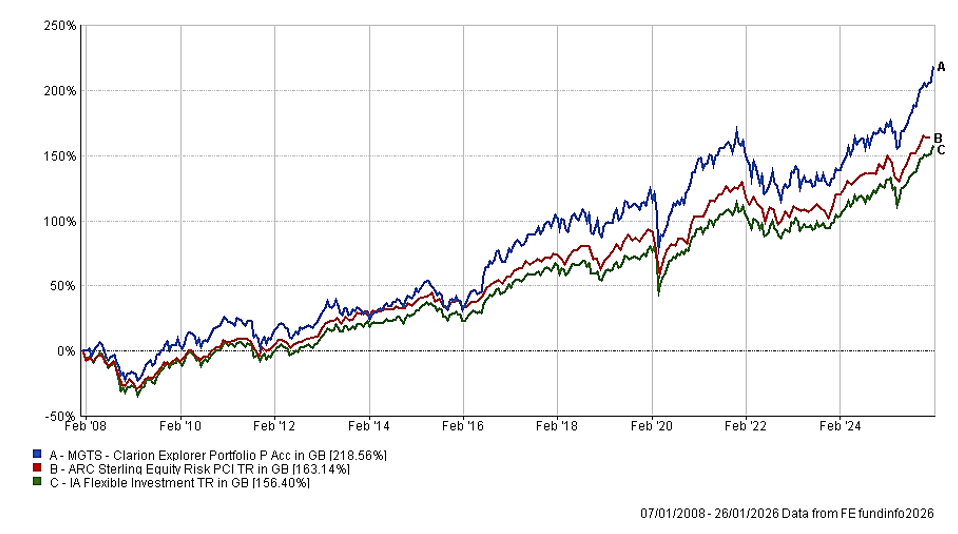
The chart below shows the historical performance of the Explorer Portfolio against a relevant benchmark since the start of the available data.
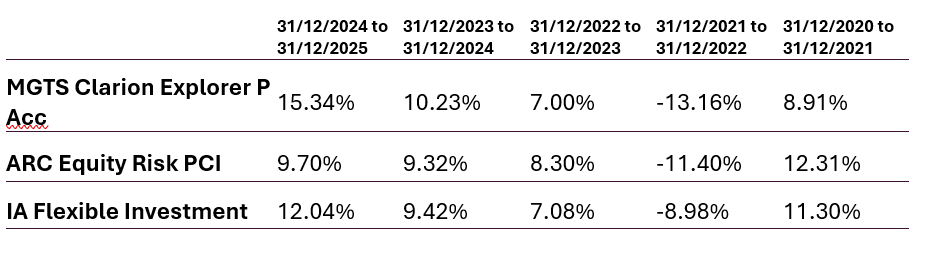
The table below shows the annualised performance to the last quarter end:
Changes to the Explorer Portfolio Fund
Holding a globally diversified portfolio of high-quality assets is important to provide resilience and grow the value of savings over the long term and remains the appropriate method for allocation of investor capital. Cash is unattractive as inflationary pressures, although moderating, look to be structurally long term.
Keith W Thompson
Clarion Group Chairman
January 2026
Risk Warnings
Any investment performance figures referred to relate to past performance which is not a reliable indicator of future results and should not be the sole factor of consideration when selecting a product or strategy. The value of investments, and the income arising from them, can go down as well as up and is not guaranteed, which means that you may not get back what you invested. Unless indicated otherwise, performance figures are stated in British Pounds. Where performance figures are stated in other currencies, changes in exchange rates may also cause an investment to fluctuate in value.
The content of this article does not constitute financial advice, and you may wish to seek professional advice based on your individual circumstances before making any financial decisions.