
True lifelong financial planning for the serious business of life.
True lifelong financial planning
for the serious business of life.
True lifelong financial planning for the serious business of life.
True lifelong financial planning
for the serious business of life.
Category: Financial Planning
Market volatility can be unsettling, and you may feel nervous about recent fluctuations amid the war in the Middle East.
Geopolitical events often trigger market movements. But while unfolding global events remain unpredictable, the long-term trends of markets have historically been far more consistent.
It’s important to remember that market volatility is a normal part of investing, and two key strategies can help you navigate the challenges of a downturn:
Read on to learn more about how these principles can help you during periods of instability.
When markets fall, your immediate reaction may be to sell off to limit further losses.
However, history shows that investors who stay the course have typically recovered more quickly than those who react to short-term dips with knee-jerk decisions.
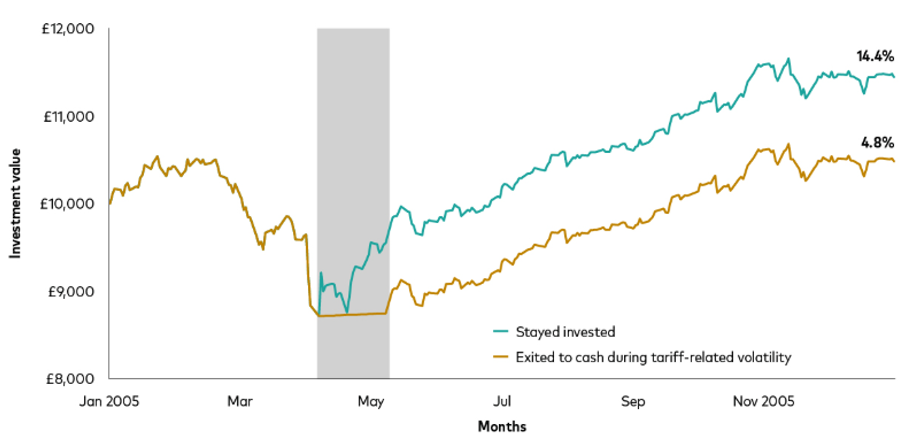
For example, Vanguard analysed what would have happened if an investor had exited during the 2025 dip triggered by US trade tariffs, then re-entered once markets began to recover. This was compared with an investor who remained fully invested throughout.
You can see the findings of the research in the graph below.
Source: Vanguard
The research revealed that even a short exit of just over a month would have left the investor nearly 10% worse off, as they missed a key part of the recovery, which shows just how costly exiting can be.
But this wasn’t just the case in last year’s dip. Further research from Vanguard looked at the market performance in the years between 1975 and 2025. That period saw multiple crises, including the bursting of the dotcom bubble, the 2008 financial crisis, wars, elections, and the pandemic, each of which brought considerable fluctuations.
The research found that if you invested £100 in global equities at the start of 1975, it would have grown to £29,307 by May 2025, if left untouched.
However, if you had exited the market every time it fell by 20% or more and then re-entered six months later, the same investment would be worth just £15,663 over the same period – almost half as much.
So, despite there being frequent uncertainty over the studied period, remaining invested would have been the more effective way to recover losses and build long-term growth.
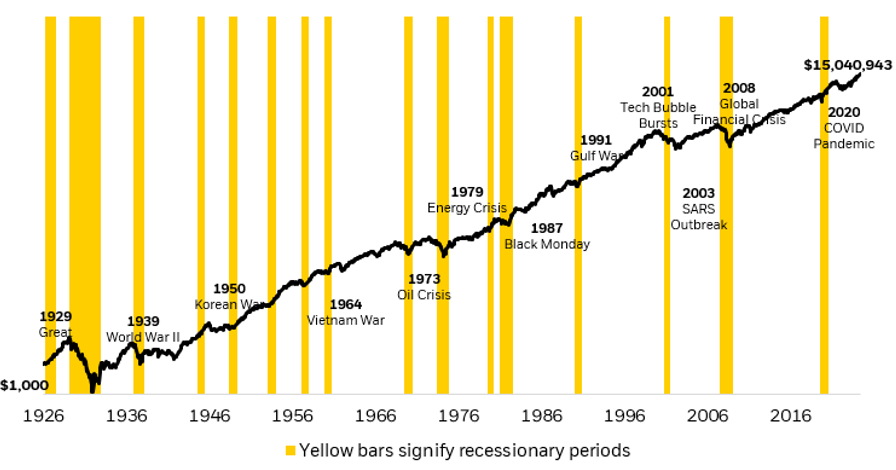
Indeed, the graph below shows the growth of $1,000 in the US stock market from 1926 to 2024, alongside major events that have caused recessions.
Source: iShares
As you can see, despite significant declines along the way, the market has continued its long-term trajectory towards growth, and $1,000 invested in 1926 would now be worth over $15 million.
So, while volatility and downturns can feel unnerving, they have historically been temporary. Staying focused on your long-term goals and not reacting to short-term noise has typically been the more effective way to build wealth over time.
Although market volatility is a normal part of investing, there are steps you can take that can help you weather fluctuations, and portfolio diversification is key.
By spreading your investments across different asset classes, sectors, and regions, you reduce the impact of any single downturn on your overall portfolio. While some areas may struggle and deliver losses, others may remain stable or deliver strong returns, which can lead to steadier growth over time.
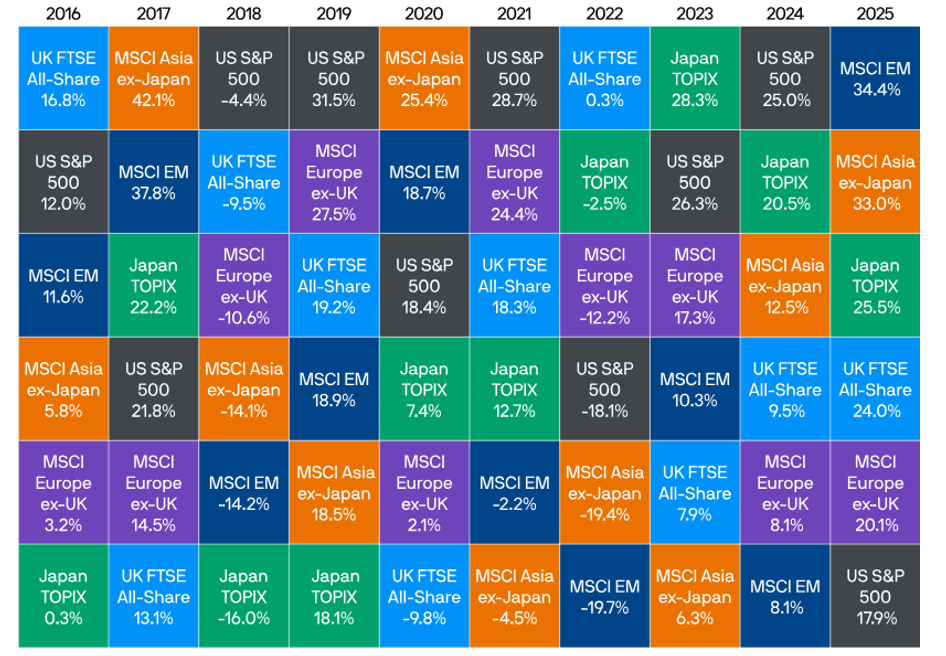
For example, the table below shows the ranked performance of major global indices between 2016 and 2025.
Source: JP Morgan
As you can see, predicting what region is going to perform well based on the previous year’s performance is all but impossible. For instance, the S&P 500 was the strongest performer in 2024 and then the weakest in 2025.
The discrepancy between the performances can also be significant. In 2020, the MSCI Asia ex-Japan grew by 25.4%, while the FTSE All-Share fell by 9.8%.
However, by spreading your investments across multiple regions, you can help offset poor performance in one area with strong returns in another, potentially leading to a more stable path to long-term growth.
In practice, diversification doesn’t eliminate risk, but it can make the journey more manageable. It can help you stay invested through periods of volatility rather than feeling pressured to react when a particular market dips.
A financial planner can provide an experienced perspective during periods of volatility to help ensure you avoid decisions that don’t align with your long-term goals.
They can help you build a financial plan to withstand uncertainty by assessing your risk profile, balancing your investments, and diversifying across sectors, regions, and assets.
They can also offer a calm and experienced voice at times when you may feel unnerved. Through their understanding and expertise of the market, a financial planner can help you focus on achieving your long-term goals and provide confidence and clarity during uncertain periods.
To speak to a financial planner, get in touch.
Email [email protected] or call us on 01625 466360.
This article is for general information only and does not constitute advice. The information is aimed at individuals only.
All information is correct at the time of writing and is subject to change in the future.
Please do not act based on anything you might read in this article. All contents are based on our understanding of HMRC legislation, which is subject to change.
A pension is a long-term investment not normally accessible until 55 (57 from April 2028). The fund value may fluctuate and can go down, which would have an impact on the level of pension benefits available. Past performance is not a reliable indicator of future performance.
The value of your investments (and any income from them) can go down as well as up and you may not get back the full amount you invested. Past performance is not a reliable indicator of future performance.
If you’d like more information about this article, or any other aspect of our true lifelong financial planning, we’d be happy to hear from you. Please call +44 (0)1625 466 360 or email [email protected].
Click here to sign-up to The Clarion for regular updates.