
True lifelong financial planning for the serious business of life.
True lifelong financial planning
for the serious business of life.
True lifelong financial planning for the serious business of life.
True lifelong financial planning
for the serious business of life.
Category: Investment management
Some months the most useful thing we can report is that nothing needed changing. This is one of them.
The Clarion Investment Committee met on 19 August. The following notes provide an overview of some of the main points of consideration in the Investment Committee discussions. They have been updated to include commentary on recent events and the wider implications for financial markets.
Please click here to access our August Stock Market & Economic Commentary written by Clarion Group Chairman, Keith Thompson.
Our investment philosophy is guided by proven financial research, applied with care by our in-house Investment Committee. We do not chase trends or make predictions. Instead, we rely on evidence, structure, and oversight to manage wealth responsibly over the long term. The point of that discipline is simple. The portfolio exists to fund your plan, and the plan exists to fund the life you want.
We focus on what can be controlled: diversification, discipline, and costs. This allows us to create efficient portfolios designed to weather uncertainty and deliver the returns that markets provide.
Our approach is built on five enduring principles, which together form the foundation of our Investment Philosophy.
Each of the five philosophy pillars reflects our commitment to managing your wealth with clarity, discipline, and care.
1) Evidence based investing. Disciplined, diversified portfolios deliver better long-term outcomes than chasing the latest market trend.
2) A systematic process. A structured repeatable process designed to remove guesswork and emotion.
3) Cost efficiency. We carefully select cost effective investment solutions without compromising quality.
4) Independent oversight. Every decision is reviewed and challenged by our in-house Investment Committee, supported by Margetts Fund Management and Dynamic Planner.
5) A responsible perspective. Identifying risks and opportunities that could affect your wealth in the years to come and building resilience into client portfolios.
Markets have a habit of testing conviction.
Only a month ago investors were questioning whether enthusiasm surrounding AI had run too far, too fast. Technology shares fell sharply, semiconductor stocks entered bear market territory, and concerns emerged that spending on AI infrastructure might be nearing a peak.
August brought a very different mood.
The sell-off largely reversed as company results from the major technology groups confirmed that investment in AI remains substantial. Spending plans by the world’s largest technology businesses continue to run into the hundreds of billions of pounds, providing reassurance that the long-term growth story remains intact. The recovery was particularly pronounced across Japan and parts of Asia, where markets had suffered some of the sharpest falls during July.
This was a reminder that markets often move ahead of underlying fundamentals, both on the way up and on the way down. Periods of short-term anxiety rarely alter the long-term trajectory of structural trends.
While equity markets were recovering, policymakers were dealing with a different challenge.
UK inflation rose to 2.9% in July, up from 2.6% the previous month. Much of the increase reflected higher energy prices, driven in part by continuing tensions in the Middle East and disruption to shipping routes through the Strait of Hormuz. Oil prices remain significantly higher than a year ago.
There are, however, signs that inflationary pressures beneath the surface are becoming more moderate. Core inflation has eased and wage growth is no longer accelerating. The labour market has also softened, with employment growth slowing and unemployment remaining close to its recent high.
Against that backdrop, the Bank of England remains in a difficult position. Inflation is higher than policymakers would like, but economic growth shows little sign of excessive strength. The likely path for interest rates remains uncertain, but the range of possible outcomes has narrowed considerably compared with the volatility experienced over recent years.
One of the more consistent investment themes over the past year has been the resilience of short-dated fixed interest investments.
Government bond yields remain elevated, with the 10-year gilt trading above 5%. This means investors are still able to obtain attractive levels of income without taking excessive interest-rate risk.
Our preference for shorter-duration bonds has continued to prove beneficial. Investors can capture much of the available yield while reducing the sensitivity of portfolios to movements in long-term interest rates.
This may seem a modest advantage, but over time small differences in risk management can have a meaningful impact on returns. The experience of recent years has reinforced the value of maintaining flexibility rather than reaching unnecessarily for duration.
The strongest market over recent months has been Japan.
After decades of economic stagnation and corporate conservatism, Japanese companies continue to improve profitability, shareholder returns and capital discipline. These changes are gradual rather than dramatic, but they represent a significant shift in behaviour.
Investors have increasingly recognised this improvement, helping Japanese equities deliver some of the strongest returns among developed markets.
The investment case for Japan was never based on a single quarter’s performance. It rests on a combination of reasonable valuations, improving corporate governance and a slowly improving economic backdrop. Those factors remain broadly intact.
One feature of August was the sharp reversal between growth and value investing.
The areas of the market that struggled most in July often led performance in August. Equally, some of the more defensive and value-oriented strategies that had protected investors earlier in the summer gave back part of that relative advantage.
Such reversals can appear dramatic when viewed over a month or two. Yet they are rarely significant in the context of a long-term investment strategy.
Indeed, many of the factors that have contributed to value investing’s success over recent years remain in place. Valuations still matter. Cash flow still matters. Paying too much for future growth still carries risk.
Short-term market leadership will continue to rotate. Long-term investment principles tend to endure.
The past few years have reminded investors that the investment environment can change quickly.
Inflation returned after being declared defeated. Interest rates rose after a decade near zero. AI emerged as a dominant investment theme almost overnight.
Yet amid these shifts, one lesson remains constant: successful investing depends less on predicting the next headline and more on maintaining discipline through changing conditions.
Markets will continue to alternate between optimism and concern. What matters is not reacting to every swing in sentiment but remaining focused on the forces that shape wealth over years rather than weeks.
Against that backdrop, our approach remains unchanged: diversified portfolios, disciplined asset allocation and a long-term perspective.
As ever, patience remains one of the most valuable assets an investor can own.
Overall, the outlook points to a more complex but still supportive investment environment. Growth is widely expected to reaccelerate, markets remain resilient and leadership is broadening across regions and sectors. For portfolio construction, this reinforces the case for diversification, selective risk-taking and exposure to structural themes such as value stocks, profitable companies and also smaller companies
We continue to maintain a reduced allocation to fixed interest investments, reflecting the challenges posed by persistent inflation. Where bonds are held, maturities remain relatively short to limit inflation risk and preserve real returns.
Equity exposure remains diversified with an underweight position in the United States, where valuations remain demanding and future AI-related returns are less certain. Greater emphasis is placed on the UK, Asia and Emerging Markets, where valuations are generally more attractive and the benefits of AI adoption are likely to be widely distributed.
Within equity portfolios, we continue to favour medium-sized and smaller companies where valuations are still reasonable and exposure to the most heavily concentrated areas of the market is reduced.
The performance of all underlying funds was compared against their IA sector benchmarks, observing that most have performed well, particularly but not limited to Dimensional Global Short Dated Bond, Dimensional UK Small Companies, Abrdn Short Dated Global Bond Tracker, iShares UK Gilts 0-5yr UCITS ETF, Dimensional Sterling Short Duration Real Return and Baillie Gifford Pacific.
Slight underperformance was noted for Dimensional Emerging Markets Targeted Value, Waystone Avantis Emerging Markets Equity ETF, FTF ClearBridge Global Infrastructure Income, BNY Mellon Global Infrastructure Income and Schroder Asian Income Z Acc. At this stage and bearing in mind current market weakness, this degree of underperformance is not of concern.
No changes to the underlying funds were considered necessary at this stage as all funds are performing in line with expectations and within their risk reward parameters.
Despite ongoing geopolitical tensions, concerns about the state of the global economy, the extent of government spending and debt, over-regulation and high taxation, and more volatile and higher inflation, the Investment Committee are cautiously optimistic about stock markets in 2026.
Holding a globally diversified portfolio of high-quality assets is important to provide resilience and grow the value of savings over the long term and remains the appropriate method for allocation of investor capital. Cash is unattractive as inflationary pressures, although moderating, look to be structurally long term.
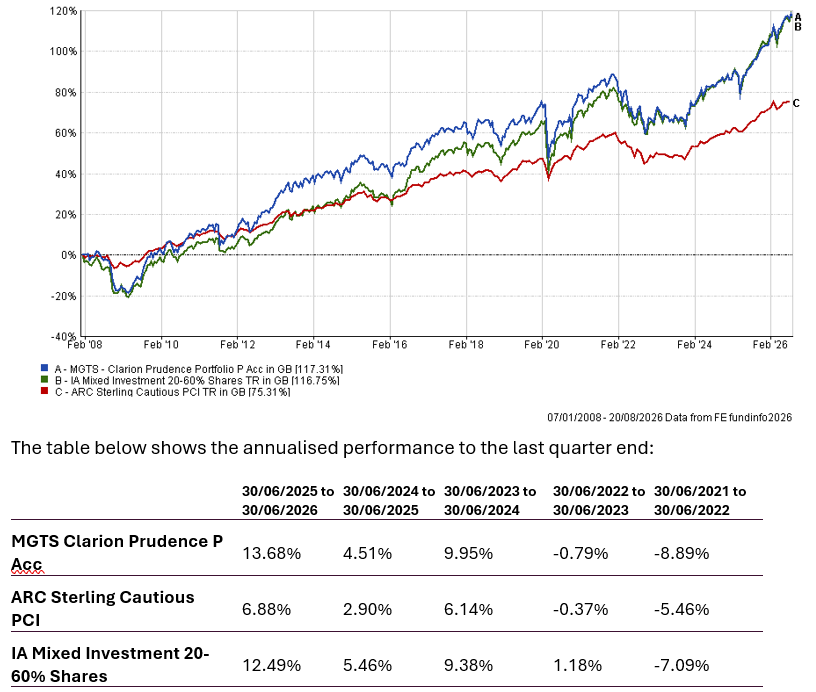
The chart below shows the historical performance of the Prudence Portfolio against a relevant benchmark since the start of the available data.
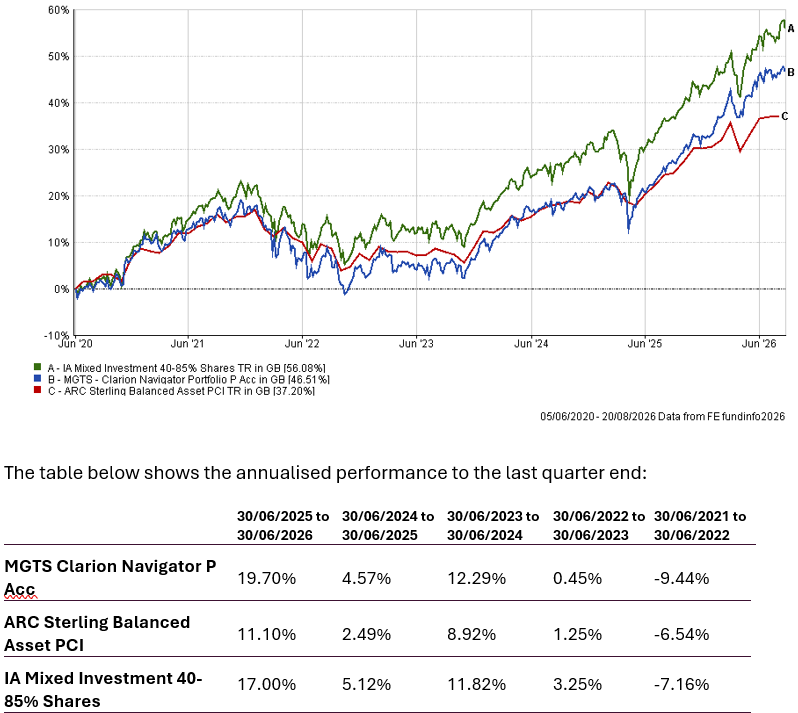
The chart below shows the historical performance of the Navigator Portfolio against a relevant benchmark since the start of the available data.
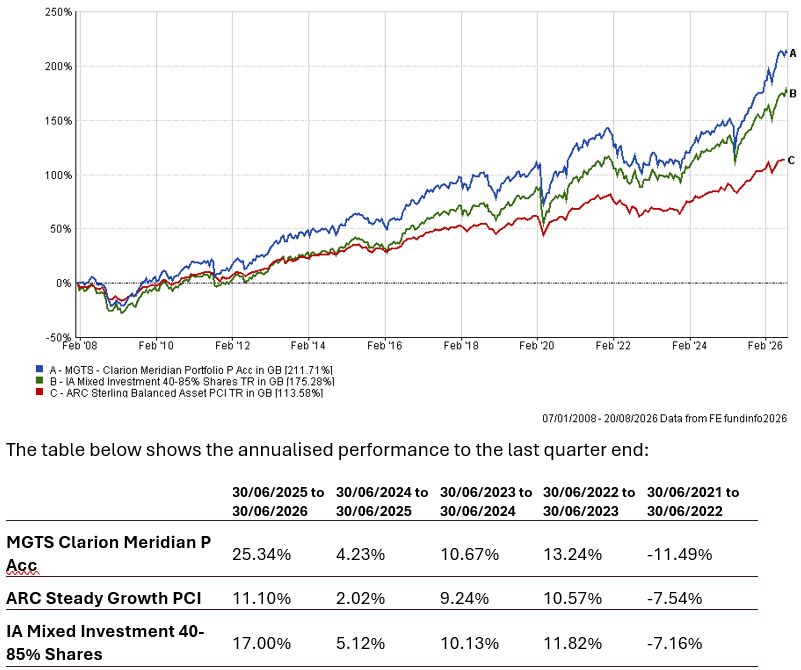
The chart below shows the historical performance of the Meridian Portfolio against a relevant benchmark since the start of the available data.
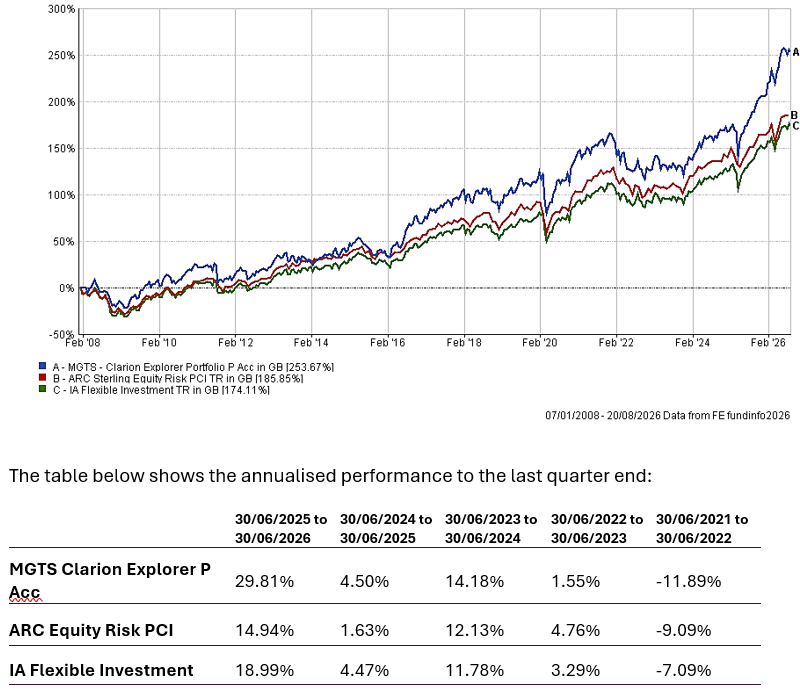
The chart below shows the historical performance of the Explorer Portfolio against a relevant benchmark since the start of the available data.
None of this changes what your plan is for. A month that required no action is usually a sign the portfolio is doing its job quietly. If something has changed in your own circumstances, that is the more useful subject for your next review.
Keith W Thompson
Clarion Group Chairman
August 2026
Clarion, At the heart of what matters in life.
Any investment performance figures referred to relate to past performance which is not a reliable indicator of future results and should not be the sole factor of consideration when selecting a product or strategy. The value of investments, and the income arising from them, can go down as well as up and is not guaranteed, which means that you may not get back what you invested. Unless indicated otherwise, performance figures are stated in British Pounds. Where performance figures are stated in other currencies, changes in exchange rates may also cause an investment to fluctuate in value.
The content of this article does not constitute financial advice, and you may wish to seek professional advice based on your individual circumstances before making any financial decisions.
If you’d like more information about this article, or any other aspect of our true lifelong financial planning, we’d be happy to hear from you. Please call +44 (0)1625 466 360 or email [email protected].
Click here to sign-up to The Clarion for regular updates.