
True lifelong financial planning for the serious business of life.
True lifelong financial planning
for the serious business of life.
True lifelong financial planning for the serious business of life.
True lifelong financial planning
for the serious business of life.
Category: Investment management
The Clarion Investment Committee met on 15 July. The following notes provide an overview of some of the main points of consideration in the Investment Committee discussions. They have been updated to include commentary on recent events and the wider implications for financial markets.
Please click here to access our July Stock Market & Economic Commentary written by Clarion Group Chairman, Keith Thompson.
Our investment philosophy is guided by proven financial research, applied with care by our in-house Investment Committee. We do not chase trends or make predictions. Instead, we rely on evidence, structure, and oversight to manage wealth responsibly over the long term.
We focus on what can be controlled: diversification, discipline, and costs. This allows us to create efficient portfolios designed to weather uncertainty and deliver the returns that markets provide.
Our approach is built on five enduring principles, which together form the foundation of our Investment Philosophy.
Each of the five philosophy pillars reflects our commitment to managing your wealth with clarity, discipline, and care.
1) Evidence-based investing. Disciplined, diversified portfolios deliver better long-term outcomes than chasing the latest market trend.
2) A systematic process. A structured, repeatable process designed to remove guesswork and emotion.
3) Cost efficiency. We carefully select cost-effective investment solutions without compromising quality.
4) Independent oversight. Every decision is reviewed and challenged by our in-house Investment Committee, supported by Margetts Fund Management and Dynamic Planner.
5) A responsible perspective. Identifying risks and opportunities that could affect your wealth in the years to come and building resilience into client portfolios.
The first half of 2026 has been shaped by geopolitical tensions, an energy supply shock, and shifting policy expectations. However, despite the more volatile and disrupted macro backdrop, the global economy has remained resilient. Economic data and corporate earnings have held up well, supported by stronger corporate balance sheets and continued investment, particularly linked to artificial intelligence. While the anticipated global reacceleration in growth has been delayed, it has not been derailed, and the environment remains constructive for investors as we move into the second half of the year.
Despite the multitude of challenges, this has been a good year for equities. Global equities are up around 9% so far this year, after rising 20% in 2025. Investor enthusiasm for risk assets has held up well, underlined last month by the biggest IPO in history, as Elon Musk’s SpaceX listed for $1.78 trillion.
This performance partly reflects the resilience of the global economy – the energy shock has not been as destabilising as initially feared. In April, a net 36% of respondents to the Bank of America Fund Manager Survey expected a weaker global economy over the next 12 months. Last month that number was less than 10%.
Besides this overall resilience, here are four themes from asset markets this year.
Global technology stocks are up 20% this year, extending their bull run to almost three years. A group of US tech behemoths, called the ‘Magnificent Seven’, has come to symbolise this rally. However, their shares have dropped nearly 10% in recent weeks, with the group now down 2% since the start of this year. Except Alphabet, all the members of this group have underperformed the S&P 500 this year, with Microsoft, Meta, and Tesla selling off.
Analysts suggest two reasons for the group’s underperformance. First, investors might be reducing exposure to these US tech behemoths due to concentration risk. The seven firms have collectively risen in value by an astonishing 200% since early 2023, increasing their share of the S&P500 from 22% to 34%. Second, some point to growing investor concerns about the hundreds of billions of dollars these firms are spending on AI infrastructure, despite significant unknowns about payoffs. The Bank for International Settlements recently compared the AI investment boom with the 1998-2000 dotcom era, and the railway mania in Britain in the 1840s, concluding that even episodes of genuine technological breakthrough “attracted capital in excess of what the commercial returns could ultimately justify.”
Investors are rotating away from the firms spending billions of dollars on AI infrastructure and towards those producing it. The Philadelphia Semiconductor Index, which tracks US chip manufacturers, is up 70% year-to-date. These valuation increases have primarily been driven by higher earnings. US chipmaker Micron last month reported a profit surge to $28.2 billion in its latest quarter from $1.9 billion in the same period last year.
This “picks and shovels” boom is not confined to the US market. South Korea’s stock market, KOPSI, is up 80%, driven by chipmaker SK Hynix, which has almost tripled in value this year, surpassing Samsung (which is up more than 150%, thanks to its chipmaking arm) as the country’s most valuable company. Shares in Dutch company ASML holdings, which sells machinery crucial to chipmaking, have risen by more than 75%. ASML now accounts for roughly 15% of the Dutch equity market. Tokyo Electron, a Japanese chipmaking equipment manufacturer, has seen its shares rise by more than 100% this year.
European defence stocks were one of the big investment stories of last year. Shares in the sector have been on a tear since Russia’s invasion of Ukraine in 2022, and doubled last year, driven by Berlin’s commitment to significantly raise military spending and NATO allies’ agreement to raise defence spending to 5% of GDP. This year, however, that rally has gone into reverse, with European defence stocks down 7%, led by a 30% fall in German defence firms.
As government bond yields have risen, in part due to the expectation of higher inflation delivered by the energy shock, investor concern about how these spending commitments will be funded has grown.
Some equity analysts also point to a shift in the nature of warfare. Emmanuel Cau, head of European equities strategy at Barclays, said “investors are looking for more tech-orientated defence stocks” as the conflict in the Middle East has shown the importance of drones. Shares in French drone producer Parrot are up around 35% this year, and those in Swedish military IT specialist MilDef have risen more than 50%.
The price of gold has fallen more than 20% since the start of the war in Iran, bucking the historical trend of the precious metal attracting safe haven flows in times of economic or geopolitical distress. The fall ends a multi-year rally. The gold price almost tripled in value from the start of 2023 to its peak in February of this year, buoyed by concerns about levels of government debt and inflation and supported by significant retail investor demand.
Higher interest rate expectations have raised the appeal of interest-earning assets compared to gold, which yields no income while incurring storage costs. A stronger US dollar has also made gold more expensive for non-US investors.
Overall, the outlook points to a more complex but still supportive investment environment. Growth is expected to reaccelerate, markets remain resilient and leadership is broadening across regions and sectors. For portfolio construction, this reinforces the case for diversification, selective risk-taking and exposure to structural themes such as value stocks, profitable companies and also smaller companies
Holding a globally diversified portfolio of high-quality assets is important to provide resilience and grow the value of savings over the long term and remains the appropriate method for allocation of investor capital. Cash is unattractive as inflationary pressures, although moderating, look to be structurally long term.
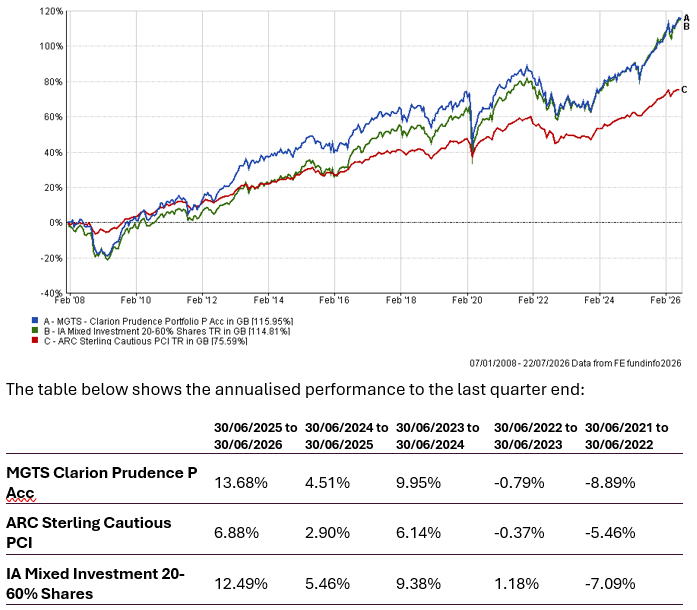
The chart below shows the historical performance of the Prudence Portfolio against a relevant benchmark since the start of the available data.
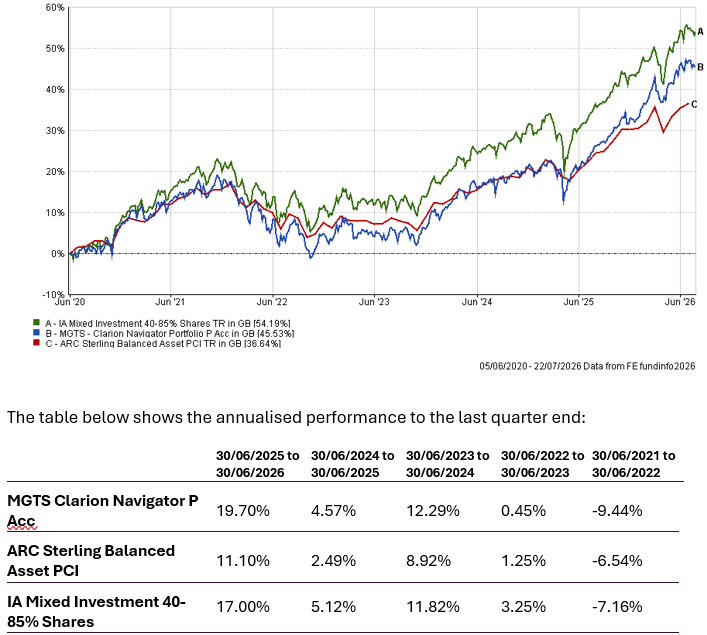
The chart below shows the historical performance of the Navigator Portfolio against a relevant benchmark since the start of the available data.
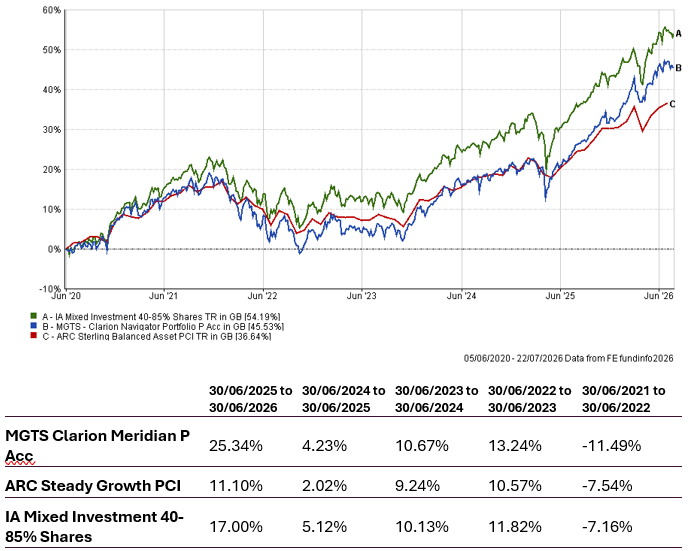
The chart below shows the historical performance of the Meridian Portfolio against a relevant benchmark since the start of the available data.
The table below shows the annualised performance to the last quarter end:
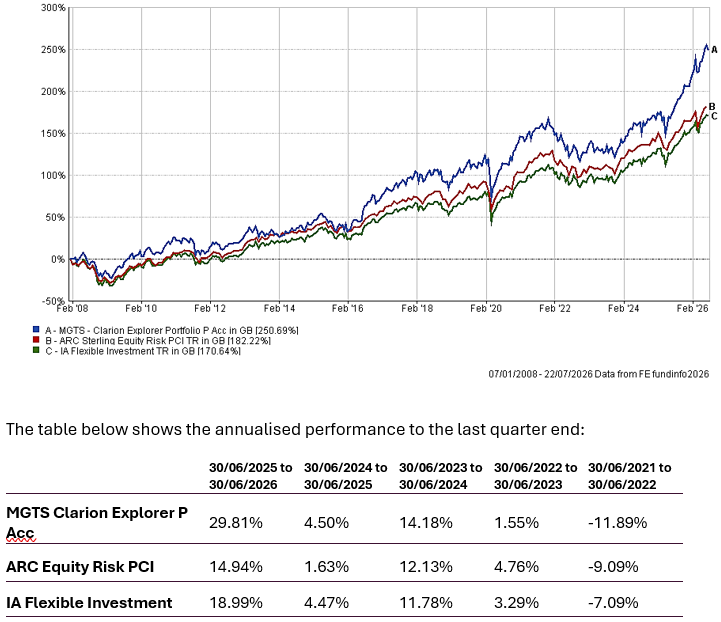
The chart below shows the historical performance of the Explorer Portfolio against a relevant benchmark since the start of the available data.
Holding a globally diversified portfolio of high-quality assets is important to provide resilience and grow the value of savings over the long term and remains the appropriate method for allocation of investor capital. Cash is unattractive as inflationary pressures, although moderating, look to be structurally long term.
Keith W Thompson
Clarion Group Chairman
July 2026
Any investment performance figures referred to relate to past performance which is not a reliable indicator of future results and should not be the sole factor of consideration when selecting a product or strategy. The value of investments, and the income arising from them, can go down as well as up and is not guaranteed, which means that you may not get back what you invested. Unless indicated otherwise, performance figures are stated in British Pounds. Where performance figures are stated in other currencies, changes in exchange rates may also cause an investment to fluctuate in value.
The content of this article does not constitute financial advice, and you may wish to seek professional advice based on your individual circumstances before making any financial decisions.
If you’d like more information about this article, or any other aspect of our true lifelong financial planning, we’d be happy to hear from you. Please call +44 (0)1625 466 360 or email [email protected].
Click here to sign-up to The Clarion for regular updates.