The Clarion Investment Committee met on 19 March at the offices of Margetts Fund Management in Birmingham. The following notes summarise the main points of consideration in the Investment Committee Discussions but have been updated to include commentary on recent events and the wider implications for financial markets.
Please click to access our March Stock Market & Economic Commentary written by Clarion Group Chairman, Keith Thompson. This commentary includes our latest thoughts (as at 27 March) on the Middle East Conflict.
The Clarion approach to investment management
Our investment philosophy is guided by proven financial research, applied with care by our in-house Investment Committee. We do not chase trends or make predictions. Instead, we rely on evidence, structure, and oversight to manage wealth responsibly over the long term.
We focus on what can be controlled: diversification, discipline, and costs. This allows us to create efficient portfolios designed to weather uncertainty and deliver the returns that markets provide.
Our approach is built on five enduring principles, which together form the foundation of our Investment Philosophy.
Each of the five philosophy pillars reflects our commitment to managing your wealth with clarity, discipline, and care.
- Evidence based investing. Disciplined diversified portfolios deliver better long-term outcomes than chasing the latest market trend.
- A systematic process. A structured repeatable process designed to remove guesswork and emotion.
- Cost efficiency. We carefully select cost effective investment solutions without compromising quality.
- Independent oversight. Every decision is reviewed and challenged by our in-house Investment Committee, supported by Margetts Fund Management and Dynamic Planner.
- A responsible perspective. Identifying risks and opportunities that could affect your wealth in the years to come and building resilience into client portfolios.
Economic Commentary & Market Outlook
The following is a summary of the major events and economic news since the last Clarion Investment Diary.
US-Iran conflict
- The US continued to mass land forces in the region.
- One of Iran’s leaders, Mohammad Bagher Ghalibaf, accused the US of using diplomatic efforts as cover to prepare for a ground invasion.
- US secretary of state Marco Rubio said the US expects the conflict to last another two to four weeks.
- In a significant escalation of the war, Iran-backed Houthi rebels in Yemen said they had launched attacks on southern Israel for the first time since the US-Israel conflict with Iran.
- US president Donald Trump said he would give Iran a 10-day extension to open the Strait of Hormuz, before the US targets Iran’s energy infrastructure, following “productive” talks with Iran. Iran said it had not held direct talks with the US, but mediation efforts were ongoing.
- The US Middle East special envoy Steve Witkoff said that the US sent a 15-point plan to Iran to end the war. Iran’s leaders are reported to have dismissed the plan and responded with counter-demands to end the conflict.
- Officials from Pakistan, Turkey, Egypt, and Saudi Arabia met in Islamabad to discuss de-escalation attempts in the region.
- Earlier in the week, Iran said that “non-hostile vessels” would be able to pass through the Strait of Hormuz “in co-ordination with Iranian authorities”. Since then, Thailand and Pakistan announced that Iran agreed to let some ships operating under their national flags to pass through the Strait
- The United Arab Emirates said that it would participate in a multinational force to reopen the Strait of Hormuz, the FT reports.
- Western intelligence suggests that Russia is sending drones, medicines, and goods to Iran.
- Iraq summoned US and Iranian officials as it accused both nations of missile strikes on Iraqi soil.
- Israel said it would widen its invasion of Lebanon to expand a security area that it intends to use as a buffer zone.
- Ukraine agreed defence agreements with Saudi Arabia and the United Arab Emirates to help counter the threat of missile attacks.
- German chancellor Friedrich Merz criticised Mr Trump for escalating the conflict and said that Germany would not help organise protection of the Strait until the war was over.
- The UK government approved a £100 million plan to reopen a carbon dioxide plant in a bid to avoid shortages of the gas, which is used by the food and drink industry.
- Lenders have withdrawn more than 1,500 mortgage products in the UK since the start of the conflict, according to finance website Moneyfacts, amid expectations of rising interest rates.
Economics
- The US Federal Reserve, Bank of England, European Central Bank, and Bank of Japan all maintained interest rates at current levels. The banks cited caution in response to the potential inflationary impacts from the Middle East conflict.
- UK gilt yields continued to rise to their highest level since 2008 following higher-than-expected public borrowing in February and the Bank of England’s warning that inflation could rise to 3.5% in the third quarter of this year.
- The UK government announced a reduction of import quotas on tariff-free steel and a 50% tariff on imported steel above these levels in a bid to support the UK’s steel industry. The new measures are similar to those implemented by the US, Canada, and EU
- The UK’s unemployment rate remained unchanged at 5.2% in the three months to January, while annual pay growth slowed to a five-year low of 3.8%.
- The UK’s House of Lords voted down a government proposal that would allow the government to force pension funds to invest minimum amounts in private assets, such as private equity and debt, as part of plans to boost UK investment.
- German economic sentiment collapsed in March due to the potential impact of the Middle East conflict on Germany’s economic recovery this year, according to research institute ZEW.
- US inflation remained at 2.4% in the year to February.
- The US economy grew at a much slower pace in the final quarter than initial estimates suggested due to downward revisions to exports, consumption, and business investment.
- The US government announced investigations against 60 trading partners, including the UK, EU, and Canada, following the Supreme Court ruling that Mr Trump’s previous tariffs were illegal.
- The US Fed said it will loosen capital requirements for large banks in a bid to boost lending.
- The EU’s six largest economies called for EU-wide supervision of capital markets as part of attempts to boost the bloc’s international competitiveness.
- German exports declined by 2.3% in January, the largest monthly fall since May 2024. However, imports fell by a greater 5.9%, meaning Germany’s trade surplus expanded to a 17-month high.
- Chinese exports increased by nearly 22% in the first two months of the year compared with the same period last year, reinforcing China’s export-led growth strategy.
- US tech equities fell sharply following a Substack blog post by research company Citrini Research that described a future scenario of mass AI disruption.
- More than 900 companies have sued the US government over its previous tariff regime, calling for a refund of tariff duties.
- UK consumer confidence unexpectedly deteriorated in February, reversing the improvement seen over December and January.
- The number of new UK work visas fell last year by nearly 20% amid tougher immigration policies, according to Home Office data.
- The Bank of England’s chief economist, Huw Pill, said the government’s policies of raising employers’ National Insurance contributions and raising the minimum wage for younger workers towards the stipulated minimum for older workers have particularly affected young people; youth unemployment is now at a ten-year high of 16.1%.
- The UK government announced £3.5 billion of extra funding for the Department for Education to cover rising costs as part of wider proposed reforms to support for children with special educational needs and disabilities in England.
- UK vehicle production declined by 14% in January compared with the same month last year, driven by a decline in exports due to weak demand in key markets.
Business
- Jensen Huang, CEO of US chipmaker Nvidia, said he expected over $1 trillion of revenue over the next two years due to growing AI demand.
- Consumer goods manufacturer Unilever is discussing the sale of its food division to food manufacturer McCormick as part of its continued shift into beauty and personal care products.
- UK chancellor Rachel Reeves said she would use compulsory purchase powers to prevent landowners from blocking developments as part of the government’s Oxford-Cambridge growth corridor plans.
- UK car park operator National Car Parks (NCP) filed for administration, citing falling demand for car parking caused by post-pandemic consumer behaviour changes.
- German bank Commerzbank rejected a €35 billion bid made by Italian-headquartered rival UniCredit.
- French president Emmanuel Macron and German chancellor Friedrich Merz agreed to set up a mediation process in attempts to resolve disagreements between companies involved in the two nations’ €100 billion fighter jet programme.
- US chipmaker Nvidia announced a $2 billion investment in AI cloud provider Nebius, the latest of a series of investment pledges in recent months.
- Anthropic sued the US government for its decision to label the AI company a “supply chain risk” following a disagreement with the US Department of War over military use of its AI technology.
- Mr Trump announced that a new oil refinery would be built in the US for the first time in nearly 50 years, backed by Indian energy company Reliance Industries.
- The Bank of England fined insurance company Direct Line £10 million for overstating its balance sheet.
- Fintech company Revolut obtained a full UK banking licence, allowing it to lend on a much greater scale.
- UK energy regulator Ofgem approved US company Tesla’s application to supply electricity in the UK, as part of Tesla’s plans to expand its product offerings to UK households.
- UK lenders withdrew around 500 mortgage products over fears of higher UK inflation and higher interest rates from the US-Iran conflict.
- Japanese car manufacturer Honda warned of a $15 billion loss over the past two years due to an overhaul of its electric vehicle strategy amid slower market demand.
- European shipping companies Maersk and MSC took control of operations of two ports along the Panama Canal in response to Panama’s Supreme Court annulling a contract with previous Hong Kong-based operator CK Hutchison Holdings following pressure from the US.
- HM Revenue and Customs collected £16 billion of extra tax from the largest businesses due to a more “hands-on approach” and growing use of data analysis, according to the National Audit Office.
- Heathrow Airport’s chief executive Thomas Woldbye said that plans to build a third runway would cost £15 per passenger over more than a decade, significantly lower than the £60 estimates from a group including airline operators British Airways and Virgin Atlantic.
- The UK opened its first lithium mining plant in Cornwall as part of efforts to boost the UK’s domestic supplies of the critical mineral used in batteries. The owner, GEL, also opened the UK’s first geothermal power plant last week.
Global & Political Developments
- Mr Trump said he would have the “honour” of taking control of Cuba as the country faces an economic crisis resulting from a US oil blockade. Cuba faced widespread power outages as a result of the blockade.
- Cypriot president Nikos Christodoulides said that Cyprus and the UK “need to have an open and frank conversation” about the future of the UK’s military bases on the island.
- The UK government is concerned about China exploiting the Freedom of Information request system to collate unclassified information that could be used to reveal sensitive information.
- The UK government is reviewing plans to expand the meningitis B vaccination programme following an outbreak around Canterbury.
- UK aid to Africa and the Middle East is set to be cut by more than 50% by 2028/29 following the government’s policy to reduce overseas aid to 0.3% of gross national income.
- Former deputy prime minister Angela Rayner said the Labour Party was “running out of time” to make positive changes to UK households.
- Ukrainian president Volodymyr Zelenskyy said that Ukraine had struck one of Russia’s “most important military factories” that produced components for Russian missiles.
- Canadian prime minister Mark Carney announced plans for $26 billion of military investment, the majority of which will be invested in the Arctic in response to an increased global focus on the region.
- Poland said it is building Europe’s most advanced anti-drone system in response to previous Russian drone incursions into Polish airspace last year.
- Russia endorsed a disinformation campaign with the aim of supporting Hungarian prime minister Viktor Orbán’s re-election bid in next month’s elections, the FT reports.
- The UK and Ireland agreed to conduct joint exercises to protect underwater cable infrastructure amid increased threats from Russia.
- UK MPs launched an inquiry into the student loan system amid recent criticism over the size of student debt after university and the repayment terms.
- The UK’s Climate Change Committee said that reaching net zero by 2050 would be a “more cost-effective path” than if fossil fuel prices rose by the same magnitude seen after Russia’s invasion of Ukraine.
- China has restricted exports of critical minerals to 20 Japanese companies amid increasing tensions between the two nations.
- The Green Party won the by-election in Gorton and Denton, a previously safe Labour Party seat. The Reform UK party came in second place. Labour Party MP Angela Rayner said the result was “a wake-up call”, with UK prime minister Keir Starmer facing renewed pressure following the defeat.
- The US and UK resumed discussions on the “tech prosperity deal”, with initial talks focused on greater collaboration in civil nuclear technologies, the FT reports.
- The NHS will set targets for helping people return to work in a bid to tackle the high costs of funding sickness benefits and high rates of inactivity due to long-term sickness.
Strategy & Summary
- Notwithstanding the market turmoil created by the Middle East conflict the Investment Committee are comfortable with the current strategy with diversification of asset class, sectors and range of funds being the key. A tilt towards value has also helped the portfolios to hold up quite well in the recent market sell off.
- The bond allocations within the portfolios target short and mid sections of the yield curve where capital appreciation is expected.
- Index linked bonds are also included in the bond allocations as a hedge against persistent inflation.
- High yield bond strategies are avoided as credit spreads do not currently offer a worthwhile risk premium.
- The US equity market is underweighted on a valuation basis and strategies within the portfolio are particularly underweight mega-cap stocks.
- The UK equity market is conversely overweighted on a valuation basis. It was noted that the UK economy is vastly different to UK PLC with over 75% of corporate earnings being derived from overseas.
- Asia, Emerging Markets and China are also overweighted as they trade below their long-term historical average. The IC believe these regions have the potential to grow their valuations in the long-term from a low base.
- UK and US small and mid-cap equity allocations also have a small weighting in the portfolios based on an attractive entry point which current valuations provide.
- The performance of all funds was compared against their IA sector benchmarks, observing that most have performed well, particularly Dimensional European Value and Invesco Emerging Markets both of which have significantly outperformed.
- All funds are performing in line with expectations and within their risk reward parameters with the exception of the Legal & General Infrastructure fund which has been under review at recent meetings because of its high US weighting. It was decided to sell this holding and reinvest the proceeds in the Clearbridge Global Infrastructure Fund and the BNY Mellon Infrastructure Fund both of which have a higher weighting to Europe. The iShares US Tips fund was also reviewed, and it was noted that performance was not in line with expectations. It was therefore decided to sell this holding and reinvest the proceeds in Dimensional Short Duration Real Return fund which has a similar inflation linked mandate and has demonstrated superior performance. This fund has a lower amc, therefore reducing the overall cost.
- Despite ongoing geopolitical tensions, concerns about the state of the global economy, the extent of government spending and debt, over-regulation and high taxation, and more volatile and higher inflation, we are cautiously optimistic about stock markets in 2026.
- The recent market sell off because of the middle east conflict has created more value in all major markets particularly Asia, Emerging Markets, Europe, Japan, and the UK where valuations are now very attractive by most historical measures. Even the US where we have been concerned about high valuations for some time is now beginning to look attractive from a valuation perspective. We do however remain concerned by the level of market concentration courtesy of the US “Mag 7” tech stocks which still poses increased risk and draws the oxygen out of the room regarding the attractions of other markets, but investor sentiment appears to be shifting. The Clarion Portfolio Funds are positioned accordingly.
Clarion Portfolio Funds
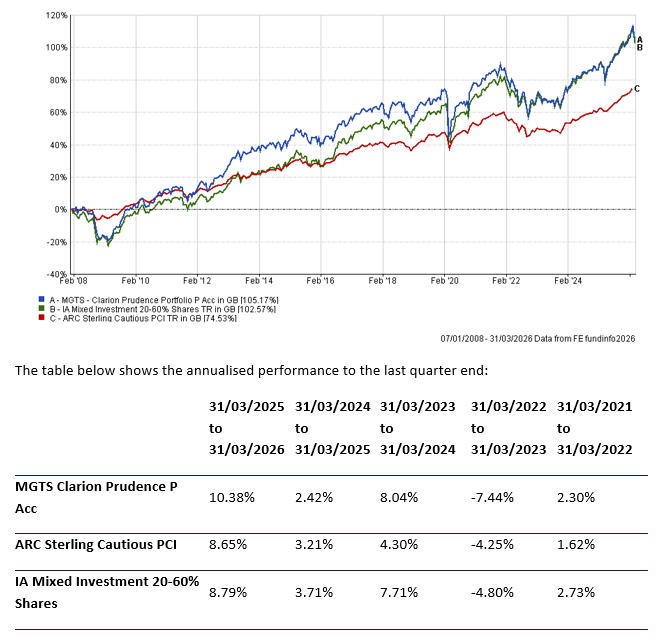
Prudence Fund
The chart below shows the historical performance of the Prudence Portfolio against a relevant benchmark since the start of the available data.
Changes to the Prudence Fund & Portfolio
- L&G Global Infrastructure Index was reduced from 3.50% to 0.00%
- iShares $ TIPS UCITS EFT was reduced from 4.50% to 0.00%
- BNY Mellon Global Infrastructure Income was increased from 2.50% to 3.50%
- FTF ClearBridge Global Infrastructure Income was increased from 2.00% to 4.50%
- Dimensional Sterling Short Duration Real Return was increased from 4.50% to 9.00%
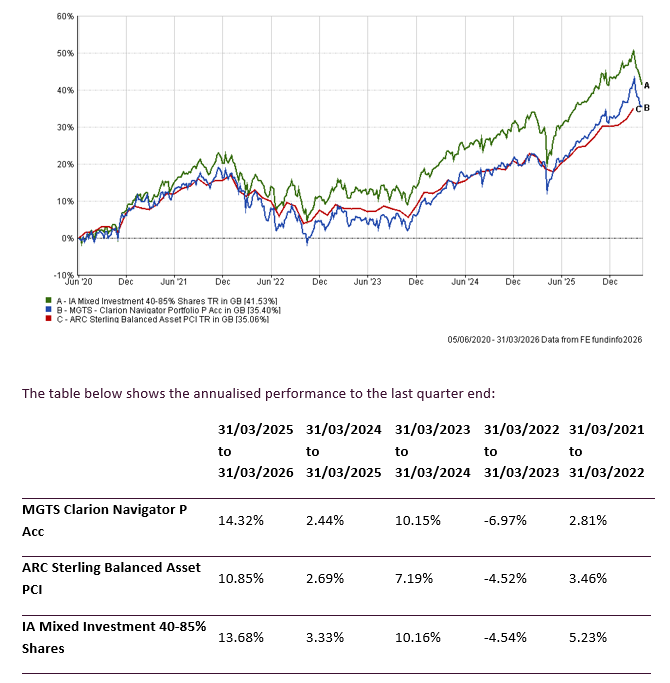
Navigator Fund
The chart below shows the historical performance of the Navigator Portfolio against a relevant benchmark since the start of the available data.
Changes to the Navigator Fund & Portfolio
- L&G Global Infrastructure Index was reduced from 3.50% to 0.00%
- iShares $ TIPS UCITS EFT was reduced from 3.00% to 0.00%
- BNY Mellon Global Infrastructure Income was increased from 2.50% to 3.50%
- FTF ClearBridge Global Infrastructure Income was increased from 2.00% to 4.50%
- Dimensional Sterling Short Duration Real Return was increased from 3.00% to 6.00%
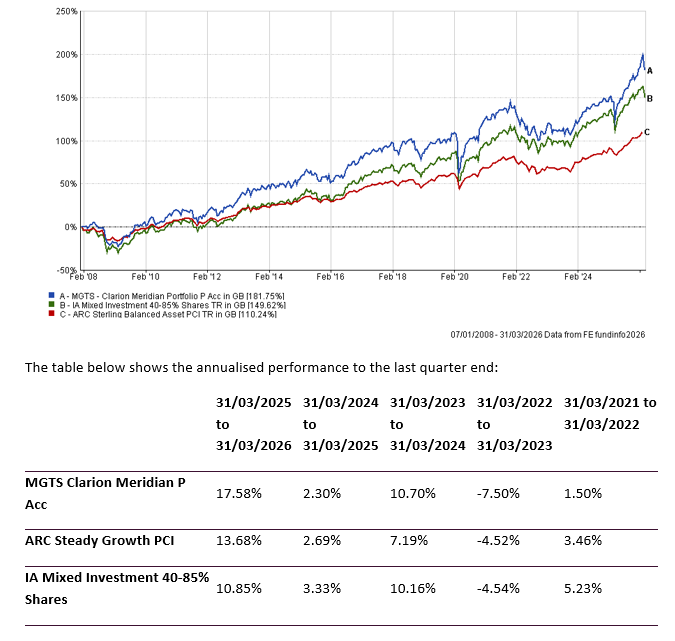
Meridian Fund
The chart below shows the historical performance of the Meridian Portfolio against a relevant benchmark since the start of the available data.
Changes to the Meridian Fund & Portfolio
- L&G Global Infrastructure Index was reduced from 4.50% to 0.00%
- BNY Mellon Global Infrastructure Income was increased from 2.50% to 3.50%
- FTF ClearBridge Global Infrastructure Income was increased from 2.00% to 5.50%
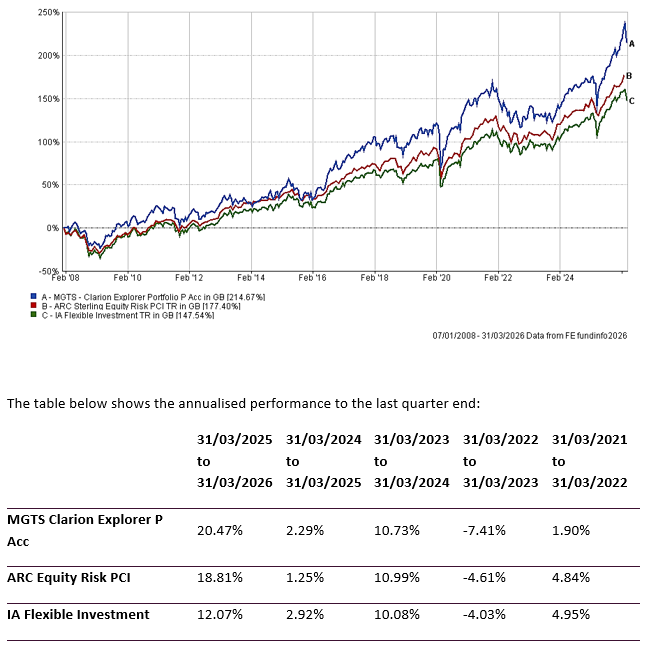
Explorer Fund
The chart below shows the historical performance of the Explorer Portfolio against a relevant benchmark since the start of the available data.
Changes to the Explorer Fund & Portfolio
- L&G Global Infrastructure Index was reduced from 4.50% to 0.00%
- BNY Mellon Global Infrastructure Income was increased from 2.50% to 3.50%
- FTF ClearBridge Global Infrastructure Income was increased from 2.00% to 5.50%
Holding a globally diversified portfolio of high-quality assets is important to provide resilience and grow the value of savings over the long term and remains the appropriate method for allocation of investor capital. Cash is unattractive as inflationary pressures, although moderating, look to be structurally long term.
Keith W Thompson
Clarion Group Chairman
March 2026
Risk Warnings
Any investment performance figures referred to relate to past performance which is not a reliable indicator of future results and should not be the sole factor of consideration when selecting a product or strategy. The value of investments, and the income arising from them, can go down as well as up and is not guaranteed, which means that you may not get back what you invested. Unless indicated otherwise, performance figures are stated in British Pounds. Where performance figures are stated in other currencies, changes in exchange rates may also cause an investment to fluctuate in value.
The content of this article does not constitute financial advice, and you may wish to seek professional advice based on your individual circumstances before making any financial decisions.