
True lifelong financial planning for the serious business of life.
True lifelong financial planning
for the serious business of life.
True lifelong financial planning for the serious business of life.
True lifelong financial planning
for the serious business of life.
Category: Investment management
The Clarion Investment Committee met on 10 September 2026. The following notes summarise the main points of consideration in the Investment Committee Discussions and have been updated to include commentary on recent events and the wider implications for financial markets.
Please click here to access our September Stock Market & Economic Commentary written by Clarion Group Chairman, Keith Thompson.
Our investment philosophy is guided by proven financial research, applied with care by our in-house Investment Committee. We do not chase trends or make predictions. Instead, we rely on evidence, structure, and oversight to manage wealth responsibly over the long term.
We focus on what can be controlled: diversification, discipline, and costs. This allows us to create efficient portfolios designed to weather uncertainty and deliver the returns that markets provide.
Our approach is built on five enduring principles, which together form the foundation of our Investment Philosophy.
Each of the five philosophy pillars reflects our commitment to managing your wealth with clarity, discipline, and care.
1) Evidence-based investing. Disciplined, diversified portfolios deliver better long-term outcomes than chasing the latest market trend.
2) A systematic process. A structured, repeatable process designed to remove guesswork and emotion.
3) Cost efficiency. We carefully select cost-effective investment solutions without compromising quality.
4) Independent oversight. Every decision is reviewed and challenged by our in-house Investment Committee, supported by Margetts Fund Management and Dynamic Planner.
5) A responsible perspective. Identifying risks and opportunities that could affect your wealth in the years to come and building resilience into client portfolios.
The month offered a familiar lesson. Markets can change direction quickly, but sound investment principles change rather less.
September began with pressure on UK assets. Rising government bond yields weighed on domestic equities, particularly smaller companies, while Emerging Markets and Asia advanced. Beneath the headline moves, however, the pattern within portfolios was more encouraging: value-oriented holdings and short-dated bonds again provided useful resilience.
This matters because a difficult month for one market does not, by itself, alter the long-term case for a diversified portfolio. It does reinforce the importance of valuation, balance sheet quality, and avoiding unnecessary exposure to interest-rate risk.
The 10-year gilt yield rose to 5.26%, while the 30-year yield touched 5.89%, its highest level since 1998. Higher yields make government borrowing more expensive and raise the return investors can obtain from bonds. This creates a tougher comparison for UK equities, especially income-oriented shares.
The immediate concern is less about recession than fiscal credibility. With the Budget due on 28 October, investors are asking whether policy can support growth while keeping borrowing under control. Sterling weakened despite higher yields, suggesting that markets are focused on that question rather than interpreting the move as a sign of stronger growth.
UK inflation rose to 2.9% in July, although core inflation held at 2.6% and services inflation eased to 3.4%. Energy prices remain a source of uncertainty. The Bank of England therefore faces an uncomfortable balance: inflation is still above target, yet growth is not strong enough to make further rate rises an easy decision.
For investors, the practical conclusion is modest. Interest-rate expectations can move quickly, so portfolios should not depend on a single forecast. Flexibility is more useful than conviction about the next policy decision.
Emerging Markets and Asia were the strongest areas over the month. The IA Global Emerging Markets sector rose 4.10%, while Asia Pacific excluding Japan gained 3.72%. Baillie Gifford Pacific returned 7.28%, outperforming its sector by 3.56 percentage points.
By contrast, North American smaller companies fell 4.00%. The divergence is a reminder that global markets rarely move in unison. Diversification is not designed to ensure that every holding rises each month. Its purpose is to reduce dependence on any single region, investment style, or economic outcome.
Dimensional UK Value was unchanged in a month when the IA UK All Companies sector fell 2.32%. Dimensional European Value also outperformed its sector. In fixed interest, short-dated holdings were comparatively steady: iShares UK Gilts 0-5yr fell only 0.10%, while Dimensional Sterling Short Duration Real Return gained 0.91%.
These are not spectacular outcomes, nor should they be presented as such. They are evidence that portfolio construction can soften the effect of difficult conditions without relying on short-term market forecasts.
The most persistent theme is still the advantage of buying sound businesses at sensible prices. Over five years, Dimensional UK Value and Dimensional European Value remain well ahead of their respective sectors. The precise figures are less important than the principle: valuation can be ignored for a time, but it is rarely irrelevant forever.
The bond experience since 2022 makes a parallel point. Long-dated government bonds suffered heavily as inflation and interest rates rose. Shorter-duration holdings were less exposed. That does not mean duration should never be extended. It means the return on offer should justify the additional risk.
Against this backdrop, our approach remains measured. We favour broad diversification, a disciplined tilt towards value and profitable smaller companies, and relatively short maturities within fixed interest. We will review positions where the evidence has weakened, but we will not confuse activity with progress.
The Clarion portfolios exist to support the financial plan, not to respond to every market movement. A month of higher gilt yields and uneven equity returns is a reason to review the evidence, not to abandon a long-term strategy. If your circumstances or objectives have changed, that is the more useful subject for your next conversation with us.
Overall, the outlook points to a more complex but still supportive investment environment. Growth is expected to reaccelerate, markets remain resilient and leadership is broadening across regions and sectors. For portfolio construction, this reinforces the case for diversification, selective risk-taking and exposure to structural themes such as value stocks, profitable companies and also smaller companies
Holding a globally diversified portfolio of high-quality assets is important to provide resilience and grow the value of savings over the long term and remains the appropriate method for allocation of investor capital. Cash is unattractive as inflationary pressures, although moderating, look to be structurally long term.
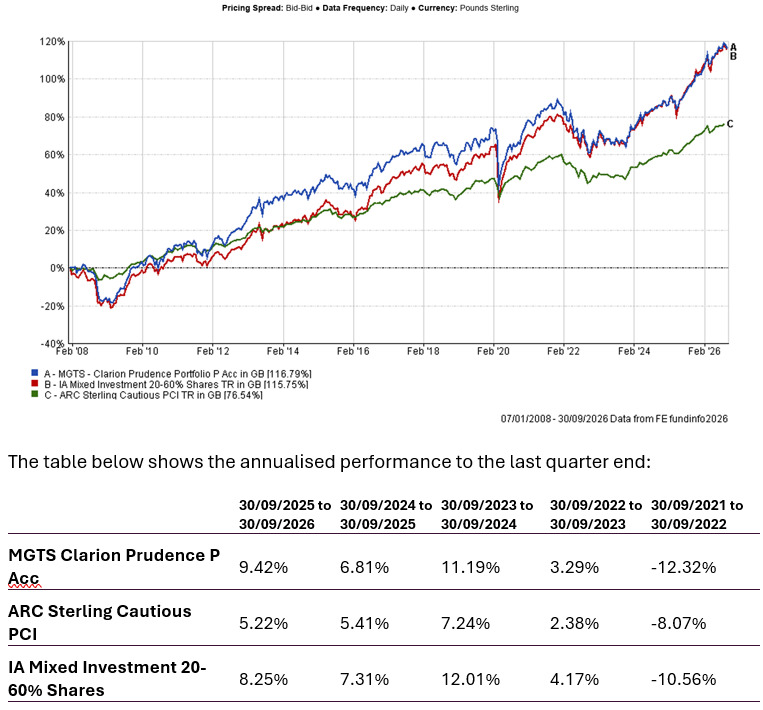
The chart below shows the historical performance of the Prudence Portfolio against a relevant benchmark since the start of the available data.
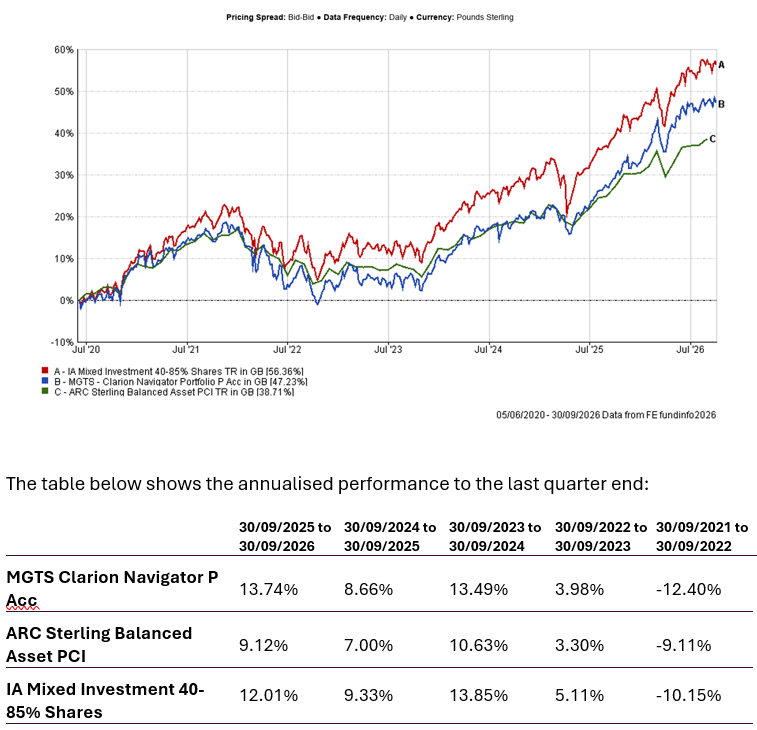
The chart below shows the historical performance of the Navigator Portfolio against a relevant benchmark since the start of the available data.
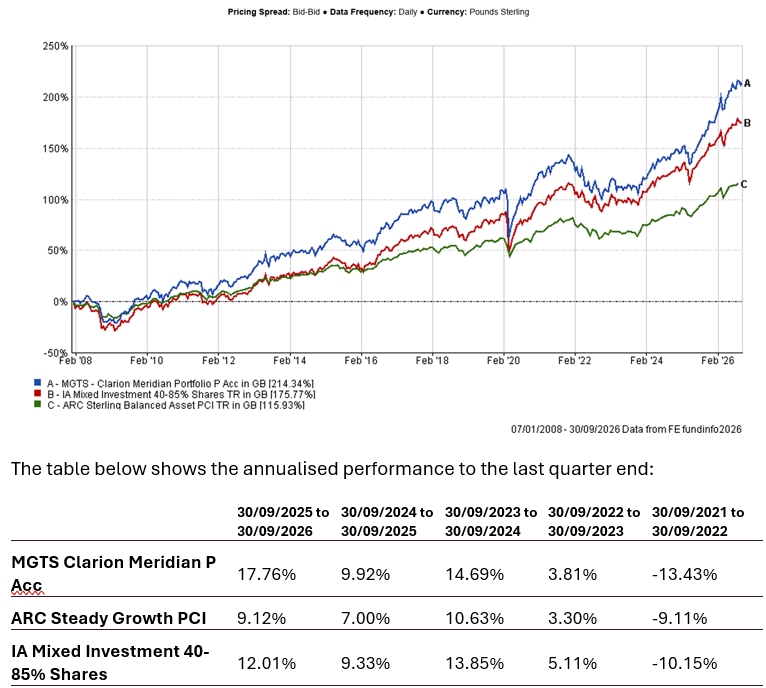
The chart below shows the historical performance of the Meridian Portfolio against a relevant benchmark since the start of the available data.
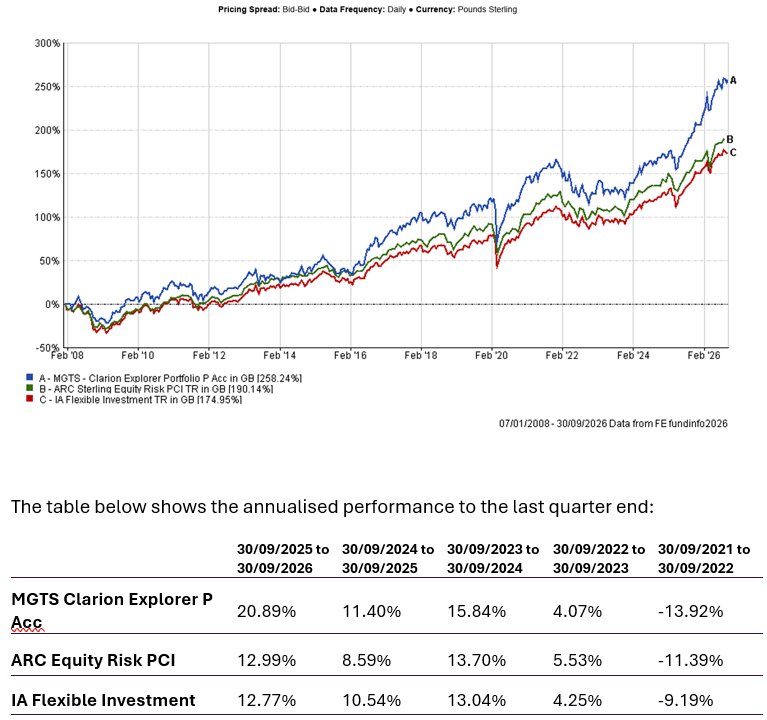
The chart below shows the historical performance of the Explorer Portfolio against a relevant benchmark since the start of the available data.
Keith W Thompson
Clarion Group Chairman
September 2026
Any investment performance figures referred to relate to past performance which is not a reliable indicator of future results and should not be the sole factor of consideration when selecting a product or strategy. The value of investments, and the income arising from them, can go down as well as up and is not guaranteed, which means that you may not get back what you invested. Unless indicated otherwise, performance figures are stated in British Pounds. Where performance figures are stated in other currencies, changes in exchange rates may also cause an investment to fluctuate in value.
The content of this article does not constitute financial advice, and you may wish to seek professional advice based on your individual circumstances before making any financial decisions.
If you’d like more information about this article, or any other aspect of our true lifelong financial planning, we’d be happy to hear from you. Please call +44 (0)1625 466 360 or email [email protected].
Click here to sign-up to The Clarion for regular updates.